Back to all news

AMS Produces Titanium AM Components for Project AMSCALE Internal Crack Research

July 2026

Additive Manufacturing Solutions Ltd. (AMS) has produced high-quality titanium additively manufactured components for Project AMSCALE, supporting work to create representative internal cracks for part qualification and the comparison of non-destructive testing techniques.

In a recent LinkedIn article titled “Internal Cracking – the Wolf in Sheep’s Clothing”, Julian Wright described a titanium additive manufacturing structure being used within Project AMSCALE to induce an internal crack.

The structure contains a beam embedded inside an outer shell. The beam is attached to the shell at each end and separated from it on its other four faces.

The design also includes a notch, shown in red, which acts as a stress raiser when the beam is excited into high-amplitude resonance.
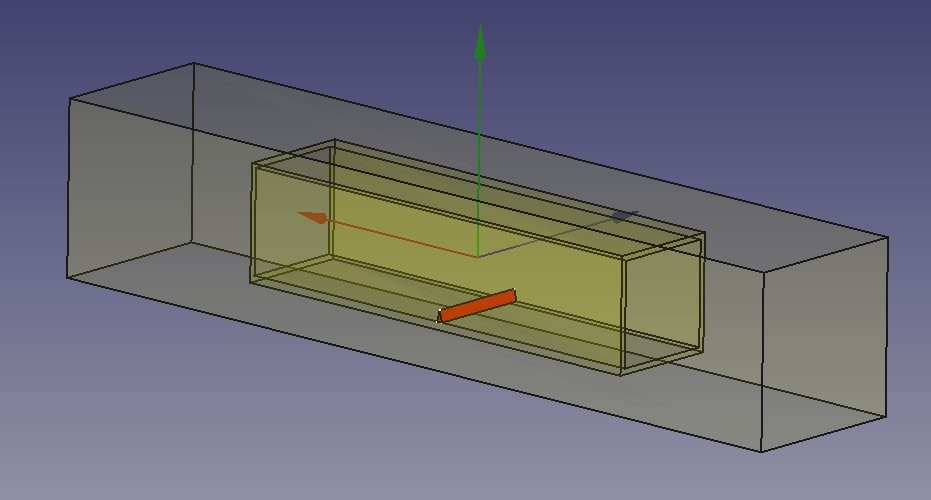
CAD design of the titanium additive manufacturing structure used within Project AMSCALE

When the detailed design has been finalised, the project plans to print 90 components and induce cracks in 60 of them. The complete set will then be used for a Probability of Detection study.

Julian described the specimen as a “Wolf in Sheep’s Clothing” because the crack is internal and therefore only visible to a subset of non-destructive testing technologies.

Project AMSCALE will investigate which NDT technologies are capable of detecting it.

The initial results came from risk mitigation trials conducted using a pre-production test component.

The crack was created using a resonance-based fatigue process. Its growth was controlled by monitoring the reduction in resonance frequency as the crack initiated and propagated.

Excitation was stopped once a predetermined change in resonance frequency, or Δf threshold, had been reached.

Following the crack-induction process, the internal beam was removed by cutting away the ends of the outer shell. The beam was then sliced in half lengthways.
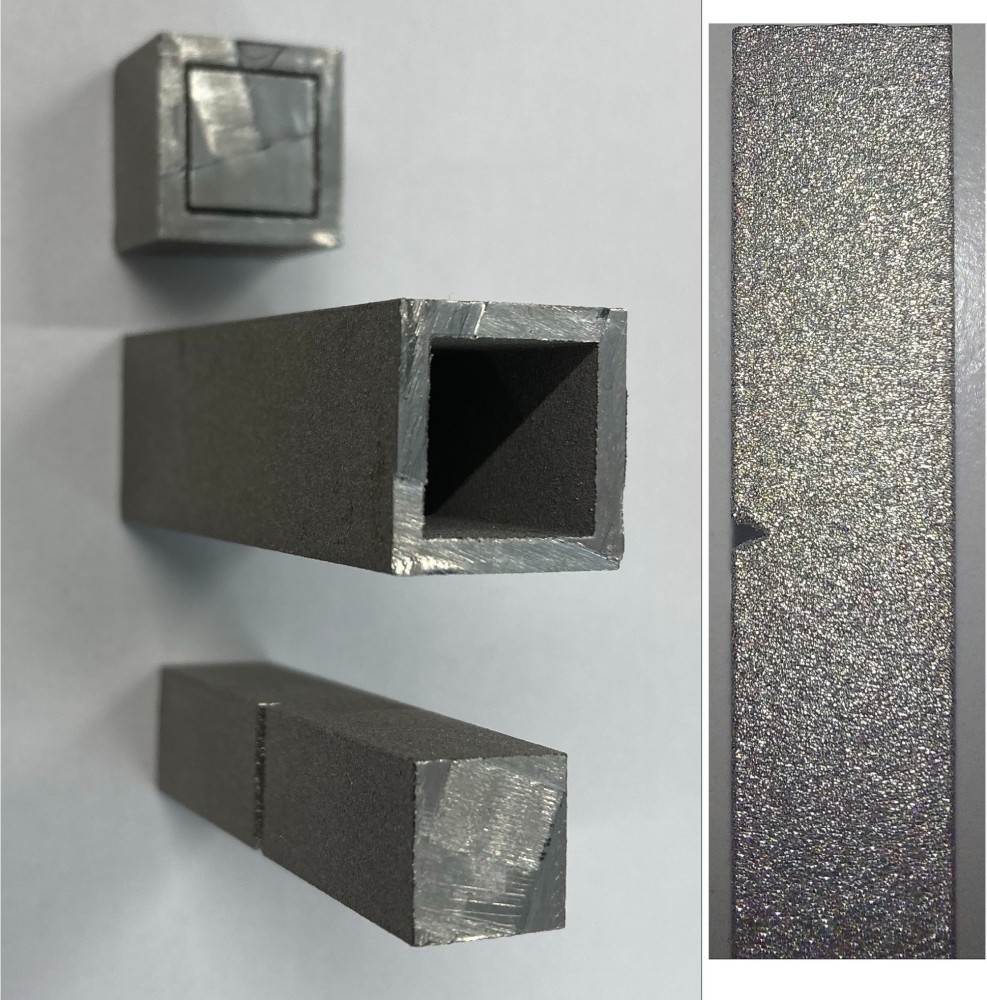
Titanium additive manufacturing component sectioned following resonance-based crack induction

The cracked section was examined by the Plymouth Electron Microscopy Centre.

The resulting electron microscopy images allowed the project team to compare the notch before and after the crack had been induced.
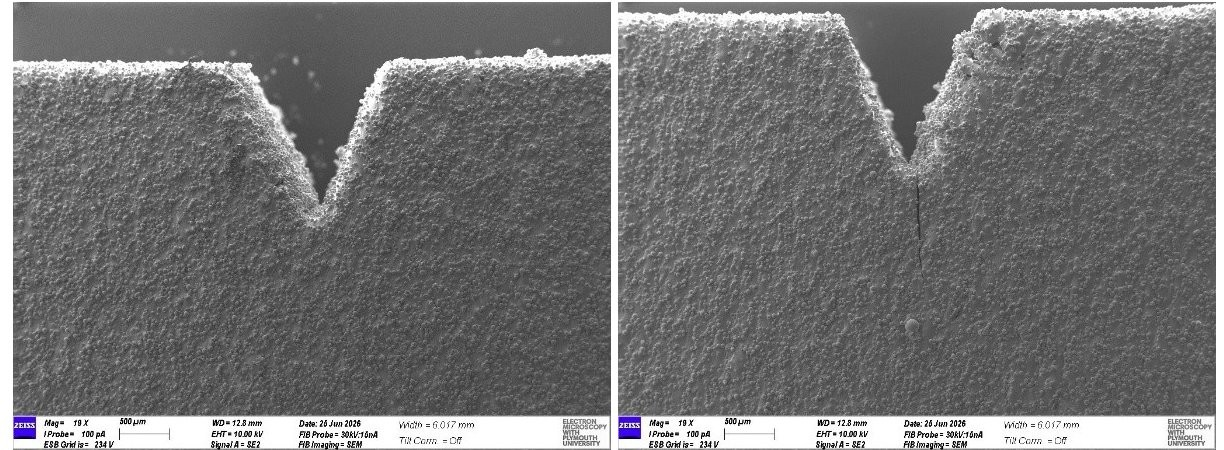
Electron microscopy comparison of the uncracked and cracked notch in the Project AMSCALE titanium component

The examination identified a crack measuring approximately 1.145 mm in length.

The separation between the crack faces measured approximately 31.14 µm at the opening and 6.9 µm near the crack tip.
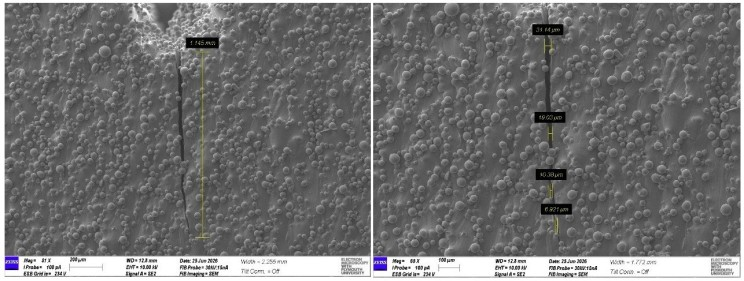
Electron microscopy measurements of the crack induced in the Project AMSCALE titanium component

Julian noted that the separation between the crack faces was larger than intended. The next trial will aim to create a longer and narrower crack.

In a related LinkedIn post, Lydia Pavey of Theta Technologies explained that this work supports the creation of Reference Quality Indicators, or RQIs.

These are components containing representative defects which can be used for part qualification and to compare different NDT techniques.

Lydia also thanked the Plymouth team for helping obtain the electron microscopy images and recognised the quality of the components produced by AMS.

“Also thanks to Robert Higham at Additive Manufacturing Solutions Ltd. for producing exceptional-quality 3D printed components that stand up to this level of magnification – no voids in sight!”

AMS’ documented contribution to this stage of Project AMSCALE was producing the titanium additively manufactured components used for the crack-induction and microscopy trials.

The quality of the printed components allowed them to be examined at high magnification, with Lydia reporting that no voids were visible in the resulting images.

The original article can be read on LinkedIn: Internal Cracking – the Wolf in Sheep’s Clothing.

Back to all news

UK Ministry of Defence highlights AMS work in sustainable defence additive manufacturing

June 2026

The UK Ministry of Defence has highlighted Additive Manufacturing Solutions Ltd. (AMS) for its role in advancing sustainable additive manufacturing for UK defence and aerospace.

The UK Ministry of Defence recently shared how old fighter jets are helping build the next generation of aircraft, recognising AMS’ work in reusing material from retired Tornado aircraft to support future aircraft programmes.

In a UK-first initiative alongside Rolls-Royce, AMS reused materials from retired Tornado aircraft to create new parts for the next-generation Tempest programme using advanced 3D printing techniques.

AMS sustainable additive manufacturing work recognised by the UK Ministry of Defence

This work forms part of a wider move towards circular and sustainable manufacturing. By reusing valuable aircraft material and applying metal additive manufacturing processes, AMS is helping demonstrate how legacy defence assets can support future aircraft, reduce waste, and strengthen UK supply chains.

Earlier this year, AMS also partnered with QinetiQ to produce a 3D-printed titanium component made from recycled aircraft material which successfully took flight. The Ministry of Defence described this as believed to be a world first.

This is a significant example of how additive manufacturing can support the defence sector by reducing waste and carbon emissions, improving supply chain resilience, and speeding up how parts are made and delivered.

For AMS, this recognition reinforces the company’s commitment to helping UK industry adopt advanced manufacturing technologies in practical, scalable and commercially viable ways.

Founder and CEO Robert Higham has been at the forefront of AMS’ work in this area, supporting the development of additive manufacturing routes that can help organisations build resilient supply chains and unlock new opportunities across aerospace, defence, motorsport and advanced engineering sectors.

AMS advanced manufacturing and defence innovation

The Ministry of Defence also highlighted the role this work plays in creating highly skilled jobs across the UK. AMS continues to invest in future talent through local apprenticeships in engineering, software and advanced manufacturing, helping develop critical skills in design, analysis, material science and production.

AMS apprentice Isaac Ashcroft was featured in the Ministry of Defence post, saying:

“I’ve had hands-on experience, real responsibility, and the support of a team helping me develop my skills while studying towards an engineering degree.”

AMS is proud to support apprentices and early-career professionals across the business, including those working in engineering, software, DevOps and advanced manufacturing roles.

This recognition from the Ministry of Defence reflects the importance of UK innovation, collaboration and skills development in delivering the next generation of defence capability.

AMS will continue to work with partners across industry, government and research to support more sustainable, resilient and effective manufacturing for the future.

Back to all news

MP Ashley Dalton Tour AMS Facilities

April 2026

We were pleased to have welcomed Ashley Dalton, MP for West Lancashire, to Additive Manufacturing Solutions (AMS) in Burscough.

Founder Rob Higham showcased how AMS transforms metal powders into high‑performance 3D‑printed components for aerospace, defence and motorsport.

MP Ashley Dalton viewing the build on a SLM 280

This circular approach delivers major benefits: reduced waste, lower costs, shorter lead times and a more sustainable manufacturing footprint.

During the visit, we also discussed the wider national focus on clean energy and green jobs, including plans for Great British Energy to expand clean power generation and support thousands of jobs by the end of the decade. AMS is proud to demonstrate how advanced manufacturing and sustainability can work hand in hand to strengthen UK industry.

MP Ashley Dalton visit AMS facilities


Ashley followed up the meeting with us at AMS, by saying “I was blown away by my tour of AMS in Burscough by owner and founder Rob Higham.”

Back to all news

11 partners join £38M DECSAM programme to scale sustainable aerospace additive manufacturing

November 2025

A group of 11 leaders in additive manufacturing (AM) has joined the Digitally Enabled Competitive & Sustainable Additive Manufacturing (DECSAM) project. Led by Airbus, this £38 million, four-year UK aerospace programme will develop and deploy the latest AM technologies—such as beam shaping and in-situ process monitoring—to make metal laser powder bed fusion (L-PBF) AM more cost-effective, productive, and sustainable for flight-ready parts. The project, which runs until June 2028, is a research and innovation initiative funded through Innovate UK, the Aerospace Technology Institute (ATI), and the UK Department for Business and Trade.

By prioritising resource efficiency, material reuse, and circular design principles, DECSAM aims to reduce waste and carbon intensity across the AM value chain, supporting the aerospace sector’s transition toward net-zero manufacturing and more sustainable aviation.

The project brings together 11 leading organisations covering aerospace OEMs, Tier 1&2 suppliers, SMEs and research institutes, providing full UK AM manufacturing chain coverage. The partners including Airbus Operations Limited (lead), Renishaw plc, ASTM International UK, Authentise Ltd, The Manufacturing Technology Centre Limited, GKN Aerospace Services Limited, Additive Manufacturing Solutions Ltd, APEX Additive Technologies Ltd, Domin Limited, University of Sheffield, and ToffeeX Limited.

“Additive manufacturing can unlock new efficiencies in aerospace, lowering costs, optimising material use, reducing weight, and consolidating complex assemblies into single parts,” said Jacqueline Castle, Chief Technology Officer at the Aerospace Technology Institute. “DECSAM unites a strong consortium to accelerate adoption in civil aerospace, aligning closely with the ATI’s additive manufacturing strategy to drive future economic growth and sustainability.”

DECSAM will demonstrate an integrated, digitally connected AM supply chain, from alloy selection and build strategies to post-processing, inspection and factory scale-up. “In order to demonstrate AMs future cost competitiveness for aerospace applications”.

What DECSAM will deliver

To cut part cost, raise quality, and shorten design-build-test loops for aerospace applications, DECSAM is structured around four innovation pillars:

  • Performance: new and improved alloys, multi-physics modelling and physics-driven design)
  • Productivity: high-power lasers, beam shaping, advanced scan strategies, in-situ monitoring and closed-loop control
  • Scalability: end-to-end digital thread, automated sustainable factory concepts, and efficient post-processing/inspection
  • Application: Integration of technologies developed to demonstrate overall cost benefit on target product applications.

Planned outputs include ground and flight-test demonstrators, validated recycled/repurposed powder routes, widened powder specifications, verified parameter themes for quality and throughput, in-process monitoring software offerings, and guidance for routes to qualification and certification, all targeted at accelerating industrial exploitation.

Our Role
Additive Manufacturing Solutions (AMS) is a knowledge and capability hub delivering metal AM from prototype through to production, backed by qualification and testing, sustainable and next-generation material development, and training via its in-house academy. Within DECSAM, AMS will focus on boosting productivity through novel scan strategies and developing sustainable material feedstocks.

Rob says “When we created AMS, we had a view and vision that additive manufactruing needed to be more collaborative to enable us to reach the heights that technology allows. Fast forward to today and to be part of this project driving next generation capabilites with our partners and collaborators enables this vision to move towards reality. Over the past two years team AMS have developed significant capabilty from recycled and sustainable materials through to novel vectoring in laser powder fusion and we are able to move these innovations through aerospace TRL structure and realise our company tagline of ‘Innovative solutions for a sustainable future.'”.

Why it matters

L-PBF is flight-proven, but wider uptake is constrained by end-to-end productivity gaps, fragmented data/QA, and reliance on overseas steps (powder, HIP, advanced heat-treat). DECSAM closes those gaps by linking UK materials supply, machine capability, in-process quality assurance, a robust digital thread, and factory scale-up—so parts are repeatable, cost-competitive, and producible at volume in the UK, supporting net-zero 2050.

The programme is business-case led: recycled/UK-made powders; optimised build and nesting; in-process monitoring with closed-loop control to reduce or eliminate HIP/CT where feasible; and parameter/alloy development to cut finishing time. Cost-modelled demonstrators (e.g., an aircraft floor beam) show the shift from today’s “as-is” to a digitally connected, production-ready “to-be” at a cost point which enables AM to buy its way into serial aerospace production.

Focus use cases include ultra-efficient wing & engine structures and hydrogen subsystems (conformal heat exchangers, fuel-cell manifolds). Alongside performance gains, DECSAM mitigates single-source casting risks, on-shores critical pre-form manufacture, and advances compact AM-enabled actuation toward power-by-wire—delivering more right-first-time, certifiable parts, shorter lead times, a resilient UK supply chain, and cleaner aerospace manufacturing.

DECSAM at a glance:

  • Value & timing: £38 million ; June 2024 – June 2028 (48 months).
  • Leadership: Airbus (project lead) with 11 project partners across OEMs, Tier-1s, SMEs, RTOs and academia.
  • Innovation pillars: Performance, Productivity, Scalability, Demonstration for L-PBF.
  • Planned outputs: Ground and flight demonstrators; recycled/reused powder routes; in-process monitoring with closed-loop control; a connected digital thread; factory design for scale-up; and clear pathways to qualification and certification.
Back to all news

Autumn Update 2025

November 2025

Here’s a brief outline of what we have accomplished since May this year.

In May, we were told by the BIBAs (Business In Business Awards) that we had been shortlisted for two awards at this year’s show: Innovative Business of the Year and Low Carbon Business of the Year. If you keep reading, we’ll update you on how that went in September.

May also featured a training day for the University of Greater Manchester (formerly the University of Bolton), whose representatives came down to learn from our experience using the . The training covered powder management and facility management, focusing on the use of additive manufacturing within a wider facility.

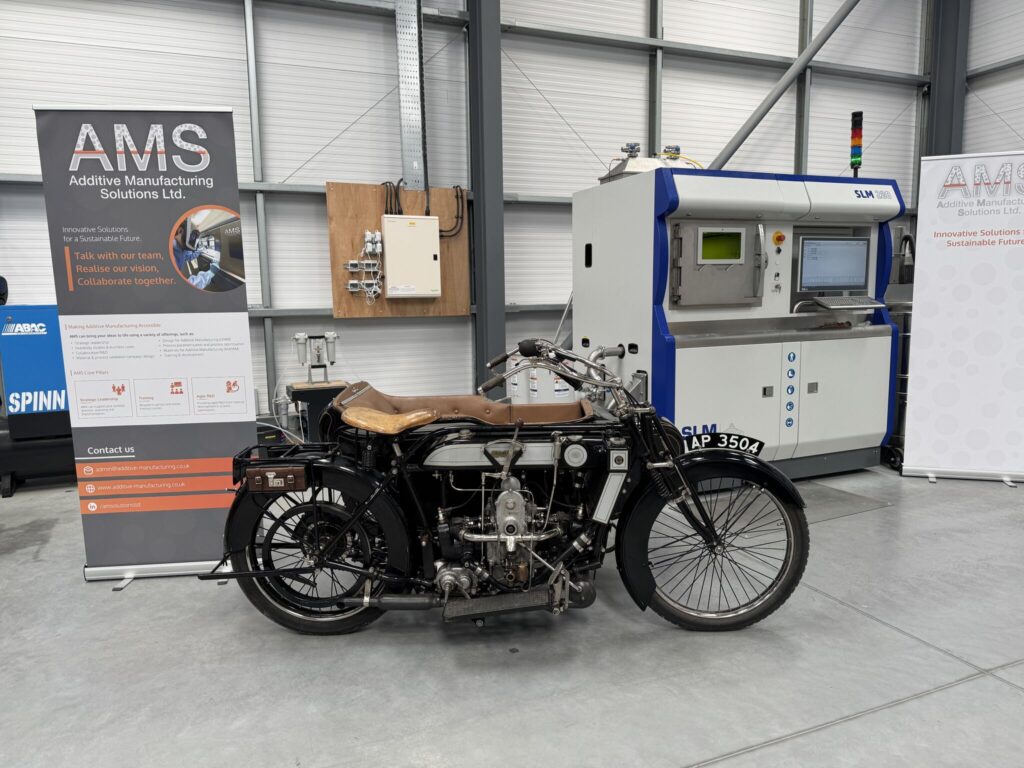
Also in May, we had a follow-up visit from John, who had previously visited us with a stainless steel part for a motorcycle. This motorcycle is a Humber, originally made in 1914. The team wanted to refurbish the motorcycle and get it running again. That’s where AMS came in. John’s team had created a CAD file for the part they needed, and we produced two of them. These parts were sent to John and his team to fit to the motorcycle. John returned to give us a demonstration of the motorcycle in action at our facility. Here are some pictures of the bike:


In early June, AMS was delighted to sponsor the TCT User Group. Our team was represented on the stand at TCT, and we were also an awards sponsor for the materials category. This two-day event was thoroughly enjoyed by all, with many thought-provoking conversations and discussions about additive manufacturing in today’s climate. Thank you to everyone who came to visit and speak with us, including those who discussed our newly announced .

PowderPro was officially announced on 30th May. Our main goal is to provide an alternative to using MS Excel for powder traceability, with a focus on powder management. For more information, you can read the TCT article [here].

September was the perfect time to announce our plans for :

  • Optimising Contour Strategies in Metal Additive Manufacturing Using X-Ray Computer Tomography (XCT)
  • Topology Optimisation and Generative Design Approaches for Lightweight Aircraft Components in Additive Manufacturing
  • Optimising Contour Strategies in Metal Additive Manufacturing Using Electron Backscatter Diffraction (EBSD)
  • Investigating the Influence of Test Variables on Hardness Measurements in Profilometry-Based Indentation Plastometry (PIP)
  • Investigating the Correlation Between Metal Powder Morphology and Flow Behaviour in Additive Manufacturing

If you are interested in any of the above, please get in touch with us using our contact form or email admin@additive-manufacturing.co.uk.

September also meant that, as a team, we completed our annual , once again with Predatech. This is our second year of achieving Cyber Essentials Plus, and this time, the assessment included the SLM 280. This certification is vital to our commitment to security, ensuring we follow the correct procedures to protect our data and any shared data we hold.

Finally, in September, the BIBAs awards took place. Unfortunately, we didn’t win either of the awards we were nominated for. However, we did receive a highly commended award for Innovative Business of the Year. While we’re disappointed not to have won, we’re grateful for the recognition.

October—normally the month for spooky tales—brought us a positive story! We were offered a place on the , which includes plans for a business trip to Germany. The focus will be on developing key market and economic benefits through collaborative events alongside our Innovate UK partners.

We’re always keen to explore continual improvement, which means aiming for a more robust system for our data. This led us to renew our for another year, allowing us to showcase our commitment to quality from the ground up. Additionally, our has been renewed, thanks to the hard work of our internal audit team. This sets us up for another year of top-quality management systems.

Back to all news

What Is Additive Manufacturing? Free Introduction Video!

April 2025

What is additive manufacturing?

Below is an introductory video into additive manufacturing. We go into detail on how the seven main types of additive manufacturing work, with our take on how we see this current technology fits into a technology readiness level, and we explore in more detail about laser powder bed fusion (LPBF), with our use of the SLM 280 and what else is required for parts to be built.

There are so many different aspects of these technologies, LBPF included, that do require much further in-depth training if you did wish to know how to do this yourself.

If you wanted to learn more about our current training offerings, please use our Academy training page to get in contact with us.

Back to all news

AMS YouTube Shorts Collection

April 2025

For those who aren’t aware, we post on pretty much all socials: LinkedIn, Instagram, YouTube, TikTok.

Below are some of the videos we have created so far, for those who don’t want to use any of those sites, and also a link to our current YouTube shorts in a nice playlist:

If you have any ideas for videos you’d like to see, use our contact form or comment on one of our YouTube videos.

Next week we’ll be releasing a wonderful introductory video around the technology of additive manufacturing, so keep an eye on our news feed for the video!


Back to all news

Strategic Command Commendation Certificate Awarded To AMS And Tornado 2 Tempest Team

April 2025

Thursday 28th March marked a special occasion for us all at Additive Manufacturing Solutions. The Ministry of Defence held its Strategic Command Defence Support Commendations event, to commend the various parties that had worked, or are working towards the help and support of those on the front lines of our armed forces.

CEO Rob Higham, pictured below at the event, had stated that the event was a “humbling and wonderful experience.” He stated on LinkedIn, “2 years ago we had just had confirmation of our first Innovate UK funding to build technical capability in our plans to create titanium powder from end of life assets.”

Tornado 2 Tempest team – Thomas Powell (MOD), Andrew Yardley (Rolls Royce), Rory Brady (Rolls Royce), AMS CEO Rob Higham (centre), VAdm Andy Kyte (CDLS), Leroy Howell (MOD), Lt. Col. Simon Watkins (MOD)

Mr Higham continued. “To be sat celebrating our progress, commitment to innovation alongside defence colleagues was a real personal wow moment to reflect on progress.”

This comes after our first major project, mentioned above, with Innovate UK entitled ‘Recycling & Reusing Aerospace Materials for Additive Manufacturing’ or shortened to ‘R2AM2’. This project involved the building of the technical capabilities of looking at the recycling of titanium from part to powder.

This event also coincides with the publication of the Defence Advanced Manufacturing Strategy, released on 28th March, which is a specific look at how additive manufacturing can positively impact the defence capabilities of the UK. This document looks at the use and adoption of additive from a governmental and defence aspect, talking about the benefits of its use as well as current use cases, such as the Tempest project which does get a mention in the Constraints (Circularity) section.

At AMS we are incredibly proud of the achievement and certification of an award for our work so far, but we understand that this is the first step in a journey, we envision a future where AM parts production continues to supply into the defence and aerospace sectors, with our hope of having recycled powder that is used on the front lines and beyond. We hope you will join us on this journey.

Strategic Command Defence Support Medallion

Do not hesitate to get in contact with us if you want to know more.

Back to all news

AMS Use Post-Processing Experts Holdson Moving Forward

March 2025

We are delighted to announce that, as of 26th March, we have reached an agreement with UK based Holdson to begin using their very own and unique electroform™ 300 unit as our post processing unit of choice.

CEO Rob Higham and CTO Neil Dickinson shaking hands

Earlier this year, we had to opportunity to get a test run of their electroform™ 300 using a test part, that when it came back from Holdson we were surprised at the quality. They also told us about how the process only takes minutes to remove up to 90% of surface roughness. This time save could save hundreds of pounds per build, which in turn could save thousands of pounds per year. At AMS, we feel this saving, alongside the ease of use with an all in one processing machine, means that it was an obvious choice for us moving forward. This partnership offers a local manufacturing contribution between the two parties which means that we can help each other in providing the best finished parts to our customers using Holdson equipment.

Post processing as part of the AM process has been a problem since the dawn of the technology, and this is something we at AMS needed help with tackling. The electroform™ 300 from Holdson offers something we have rarely seen in the industry: efficiency, effectiveness and environmental, all at the forefront of the product, which then allows us to offer a more streamlined and compelling solutions to our customers post processing needs.

For more information about the electroform™ product series, I’d highly recommend watching their videos on YouTube and follow them on LinkedIn.

If you would like more information on how we will use the electroform™ 300, please get in touch with us via our Contact Form.

Back to all news

What is Tornado 2 Tempest?

February 2025

This is the sort of question we’ve been hearing in recent days, so we thought we would share a video that was created by the RAF as a project update, giving you an insight into the how’s, why’s and who’s who of the project.

This is the sort of project that comes around once in a thousand years, being able to to work on a project that is aligned with our own visions of using advanced manufacturing technologies whilst trying to help the UK become a more environmentally sustainable outfit in all areas. The first part of the project was to show that we could help prove that we could use parts from an old Tornado aircraft and create a new part for the next generation of aircraft, the Tempest.

If you have any further specific questions or queries, please do get in touch and ask us whatever you like: Contact.